
Photo by Shutter Speed on Unsplash
Don't be me. I built the product instead of the distribution, and yes building your app is lonely like in the alps.
Without AI, building what sprkly is today would have taken me 2 to 3 years alone. The incumbents had teams and years to grow into it. I had Claude Code, Codex and a lot of late nights.
The sprkly website went up in February. Between then and now, it's been through more versions than I can count. The first version you could really use came in June, once Meta approved our posting access. Finally, we could post to Instagram, YouTube Shorts and TikTok.
By the end of September, the features matched the tools I was up against. We could post to 5 or 6 platforms and run comment-to-DM automations. Job's not done though. Our UI/UX still looked terrible, so we kept grinding. To stand toe to toe, we needed proper onboarding, a posting flow that actually flows, a scheduler and a calendar. Postiz had an agentic scheduler, so we listed sprkly's MCP server on every MCP directory we could find.
Then I checked who had seen any of it. By the end of October: 10 sign-ups. Including me.
We'd also been trying to post every day. That was unmanageable, so we dropped to 1 or 2 quality posts a week. Spamming our accounts with carousels wasn't working anyway. Instagram rewards quality, and Reels get far better reach. We weren't making Reels at all.
What I put off
- Posting on my own accounts. Before we started posting on sprkly's handle, we were basically in a bubble, building what we thought the ideal scheduler should be.
- Outreach. Any technical founder will tell you outreach is hard. We started our agentic cold outreach about 2 weeks ago. About 170 emails in, zero yeses. That's fine. The point is getting seen, not waiting to be found.
- Content like this. We published our first long-form piece on the blog just last week. The plan is hub and spoke: one long piece, cut into bite-sized posts for every platform. We'll keep doing it, because it grows sprkly as a business too.
Why did I put it off? As a technical founder, the habit is to perfect the product and launch when it's perfect. So the "hey, I'm building this" post, or the "here's how this began" story, gets pushed back every time. Then you start thinking building is hard.
It's not. It's hard when you don't look around for feedback. A solo founder's life is chewing through every bit of feedback you can get and working out how to improve. Not improving your product, but your offering as a whole.
You could be the next Da Vinci. If you can't talk about your work, nobody will know you.
What talking to people taught me
The best product feedback came from calls with warm leads:
- "Design's not great."
- "Can it stagger posts?"
- "ManyChat's UI is easier to understand."
- "Your settings page is too confusing."
I also signed up for trials with rivals, to see the gap and close it.
None of that happens until people can find you.
Why start early
- It compounds. Like an index fund: small gains stack, authority snowballs, and your audience grows while you sleep.
- The right people find you. Post about what you do, and the people who need it drift your way. That's how you find your customer, instead of guessing.
- You learn faster. Every post and every reply is free feedback.
The channels I use now, and how they're going
- Short-form socials (Instagram, TikTok, Facebook, X, Threads). 1 to 2 good posts a week beats a daily grind. Reels are next on my list.
- Communities (Facebook groups, Reddit). Read the rules first. Some subreddits ban tools like ours outright.
- Search (SEO, and showing up in AI answers). A slow burn. Nothing for weeks, then it starts to add up.
- Long-form content, like this. One piece feeds a week of posts.
- Paid ads. We tried Meta ads. 77 clicks, 0 sign-ups. Paused. Haven't cracked this one yet -> we ran for lead generation, but 0 impact, didn't get seen enough, so we killed it.
- Cold email. AI makes it easy, so everyone does it, so replies are low. An AI agent sends ours. 170 sent, 0 yeses, still worth it for the eyeballs. If you got one of ours, you're probably who we built this for. Thanks for reading.
- Referrals and affiliates. We launched our affiliate program this month. Early days.
- Launch sites. We're on SaaSHub, PeerPush, Fazier and Product Hunt (our launch there is still to come).
- MCP directories. If your app has an MCP server, list it. Cheap to do.
- Free tools and open source. Put them on your site and on GitHub. Our carousel maker is open source.
Is it a lot? Yes. Each channel needs either tech work or writing. Start with one.
What the market taught me
- Inertia. Why would anyone move their whole workflow to you? You need a reason they can say in one line.
- Cost to acquire. If you look like every other tool, every customer costs you more to win.
- Cost to switch. Moving tools is a pain. Make it worth their time.
- Friction. "Your settings page is too confusing" was friction, plain and simple. Too many clicks and people leave on day one.
- Pricing words. If your plans read differently from what people expect, that's friction too.
And one more: find where your buyers look. Reddit, Upwork, Fiverr. People posting that they need what you do: that's demand. People like us offering the skill: that's supply. Go where the demand is.
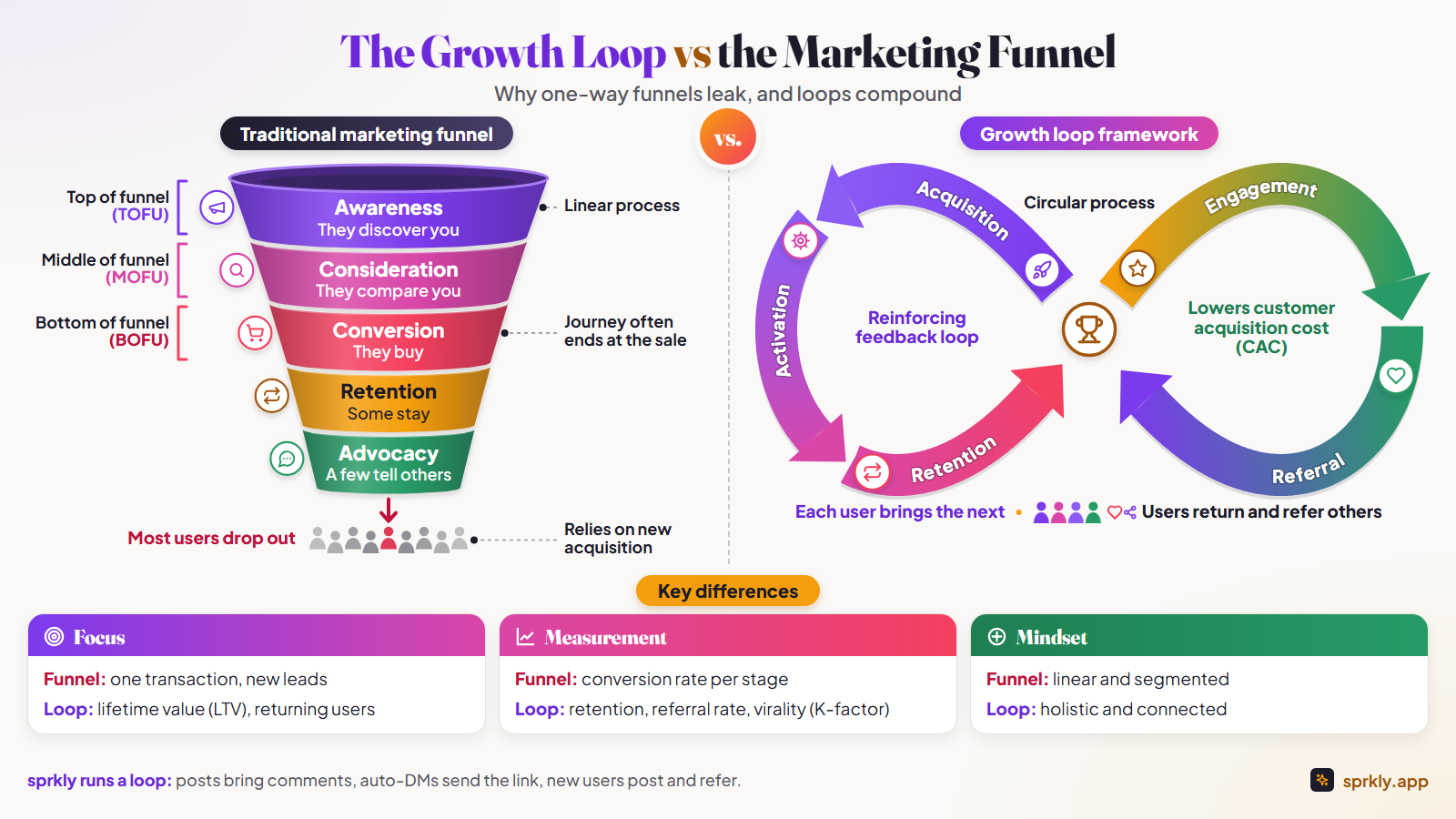
Funnels leak. Loops grow.
Most of us build a funnel: get people in, hope some pay. What actually grows is a loop: every user brings in the next one.
Do it in reverse
Build the distribution. Then the product. Then get feedback. Then distribution again.
If you've just started: post somewhere today. Talk to one person this week.
I'm building sprkly: one app to schedule your posts and turn comments into DMs. There's a free plan. sprkly.app
P.S. Know a founder who needs this? Our affiliate program pays 30% for 12 months. sprkly.app/affiliates
Cheers, Alan